
Why General Contractors Need Prequalification Software
May 1, 2026

In construction, margins are always tight and project complexity continues to increase. General Contractors are under constant pressure to make informed decisions especially when it comes to selecting the right trade partners for the job. Prequalification software has emerged as a critical tool in this process. It has become a foundational component of risk management.
The Purpose of Prequalification
Prequalification is more than a box-checking exercise. At its core, it is a structured evaluation of trade partners’ financial stability, safety record, experience, capacity, and overall reliability. Traditionally, this process has been handled through spreadsheets, emails, and fragmented documentation. Traditional methods have become inconsistent and difficult to maintain and track insurance documents.
Prequalification software standardizes this evaluation. It centralizes data, enforces consistency in how trade partners are assessed, and provides a historical record that can be referenced across projects and over time. This consistency and visibility creates a complete picture of the overall stability of a trade partner. General Contractors who use Prequalification software can make a more informative decision on their trade partners based on having their performance and financial history at their fingertips..
The Risks of Not Using Prequalification Software
Failing to implement a structured, Prequalification software exposes General Contractors to several risks. Each risk, either alone or in combination with another, has the potential to result in the General Contractor losing all project profits or, in the worst case scenario, going bankrupt.
1. Incomplete or Outdated Information
Without a centralized system, trade partner data is often scattered across inboxes and files. This increases the likelihood of relying on outdated financials, expired insurance certificates, or incomplete safety records, any of which can lead to poor selection decisions.
2. Inconsistent Evaluation Standards
When different project teams evaluate trade partners using different criteria, the result is inconsistency. One project may apply rigorous standards, while another may overlook critical warning signs. This lack of uniformity introduces unnecessary variability and risk into the company.
3. Increased Financial Exposure
Selecting an underqualified trade partner can lead to delays, cost overruns, rework, and even default. Without a formal prequalification process, these risks are amplified, as decisions may be based on relationships or incomplete vetting rather than verified data.
4. Compliance and Liability Issues
Regulatory requirements, insurance obligations, and safety standards are becoming more stringent. Inadequate documentation or failure to properly vet trade partners can expose General Contractors to legal and financial liabilities, particularly in the event of an incident.
5. Inefficiency and Lost Opportunities
Manual processes slow down decision-making. When bid timelines are tight, the inability to quickly identify qualified trade partners can result in missed opportunities or rushed decisions that compromise project outcomes.
Learn risk scenarios associated with not using Prequalifcation software and the impact it could have on your business.
The Importance of Workflow-Driven Software
Not all prequalification tools are created equal. The most effective solutions are those that do more than store data, they actively support and enforce your company’s workflow processes.
1. Structured Data Collection
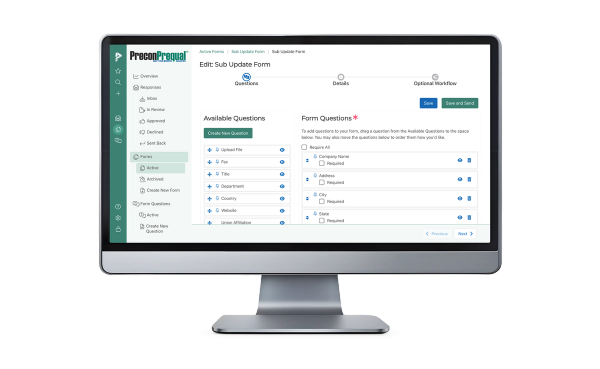
Workflow enabled prequalification software ensures that trade partners submit all required information in a standardized format. Required fields, validation rules, and automated reminders help maintain data integrity and completeness.
2. Defined Review and Approval Processes
Prequalification software that routes submissions through your company’s predefined review stages, assigning responsibility and ensuring accountability helps eliminate ambiguity around who is responsible for approvals and reduces bottlenecks.
3. Real-Time Visibility
Workflow driven software provides clear visibility into the status of each trade partner’s prequalification process. Project teams can quickly determine whether a trade partner is approved, pending, or non-compliant, enabling faster and more confident decision making.
4. Auditability and Documentation
Every action within the workflow is recorded, creating a defensible audit trail. This is particularly valuable in the event of disputes, audits, or compliance reviews, where documentation is critical.
5. Scalability Across Projects
As companies grow, maintaining consistency becomes more challenging yet more important than ever. Prequalification software that supports workflow ensures that standards are applied uniformly across all projects, regardless of team or location.
Moving Toward a More Structured Approach
Historically, the construction industry has relied on relationships and experience to guide trade partner selection. While these factors remain important, they are no longer sufficient on their own. The increasing complexity of projects, combined with heightened regulatory and financial pressures, demands a more disciplined, data-driven approach.
Prequalification software enables that shift. It transforms a fragmented, manual process into a structured system that enhances visibility, consistency, and accountability. More importantly, it helps General Contractors mitigate risk, not by eliminating uncertainty entirely, but by ensuring that decisions are made with the best available information and within a structured framework.
In an industry where a single misstep can have significant downstream consequences, the value of a robust prequalification process cannot be overstated.
Recent Posts

Top 12 Reasons General Contractors Choose PreconSuite® Over BuildingConnected®
September 8, 2026

Rick Dill is Featured in This Month’s DCD Magazine
August 20, 2026

How PreconSuite Was Founded: Rick Dill's Mission to Modernize Construction Bidding
August 14, 2026
Business Units: What are They and When Would I Use Them?
June 22, 2026

The Top 4 Reasons Trade Partners Don’t Respond to Bid Invitations
June 9, 2026